
Arrest Records in Bell County
Arrest records start with the police. When an officer takes a person into custody, that arrest gets logged. In Bell County, the Sheriff's Office under Sheriff Bill Cooke runs the county jail and books people from many agencies. City police in Killeen, Temple, Belton, and Harker Heights make arrests too, and many of those bookings flow into the same county jail. An arrest record shows who was booked, the charge, the arresting agency, the bond, and a booking photo. It also shows a docket number that ties the booking to a court case.
An arrest record is not the same as a criminal court record, and neither one proves a conviction. The booking line says a person was charged. It does not say how the case ended. A charge can be dropped, reduced, refiled under a new cause number, or sent to a grand jury. For the full case history, plea, and final result, the clerk files are the better source, and the Bell County court records page walks through that side. The jail roster is the fastest way to confirm a recent arrest, while the court file confirms the outcome.
How to Search Bell County Arrest Records
The quickest tool for recent arrests is the county Inmate Inquiry Portal. It lists people booked into the Bell County jail and updates hourly. You can search by name, subject number, or booking number, and you can set a booking date range to catch a recent intake. The portal does not publish a separate "arrest blotter," so the live roster is the main public window into who was just booked. For people no longer in custody, clear the In Custody box and search a wider date range.
- Open the Bell County Inmate Inquiry Portal and enter a name or booking number.
- Set a booking date range if you are looking for a recent arrest.
- Open the matching profile to view charges, bond, arresting agency, and the docket number.
- Take the docket number to the court portal to follow the case to its result.
The full roster, profile fields, and how to read a booking are covered on the Bell County inmate records page. For the charge and the case file behind an arrest, the District Clerk holds felony records and the County Clerk holds misdemeanor records. Both index through the county Odyssey portal.
Arrest Records vs. Criminal Court Records
An arrest record is born at booking. A criminal court record starts later, once a prosecutor files a charge or a grand jury returns an indictment. These two records live in different offices and answer different questions. The booking line tells you a person was arrested. The court file tells you what the State did with that arrest and how it ended. Many people confuse the two, then assume an old arrest means a conviction. It does not.
Bell County splits the court side by court level. Felony files sit with the District Clerk's Criminal Department, which supports the 27th, 264th, and 426th District Courts among others. Misdemeanor files sit with the County Clerk. The table below lines up the basic differences.
| Arrest Record | Criminal Court Record | |
|---|---|---|
| Source | Sheriff / Police | District Clerk or County Clerk |
| Created When | Booking | Charges filed or indicted |
| Contents | Booking info, charges, bond, mugshot | Pleadings, motions, plea, disposition |
| Best For | Confirming a recent arrest | Confirming the final outcome |
District Attorney and Victim Services
After an arrest, the case moves to the prosecutor. The Bell County District Attorney for the 27th Judicial District is Stephanie Newell. Her office reviews charges, takes felony cases to the grand jury, and decides what to file. That review is why a booking charge and the final court charge can differ. The DA office sits at the Bell County Justice Center, 1201 Huey Road, Suite 2100, in Belton, and can be reached at (254) 933-5215.
The DA also runs a Victim Services Division. Crime victims can ask about restitution, protective orders, victim impact statements, and crime victims' compensation. Victims who want release alerts can sign up through VINE rather than checking the roster over and over.
The District Attorney page links staff profiles, victim services, forms, and a public information request form.
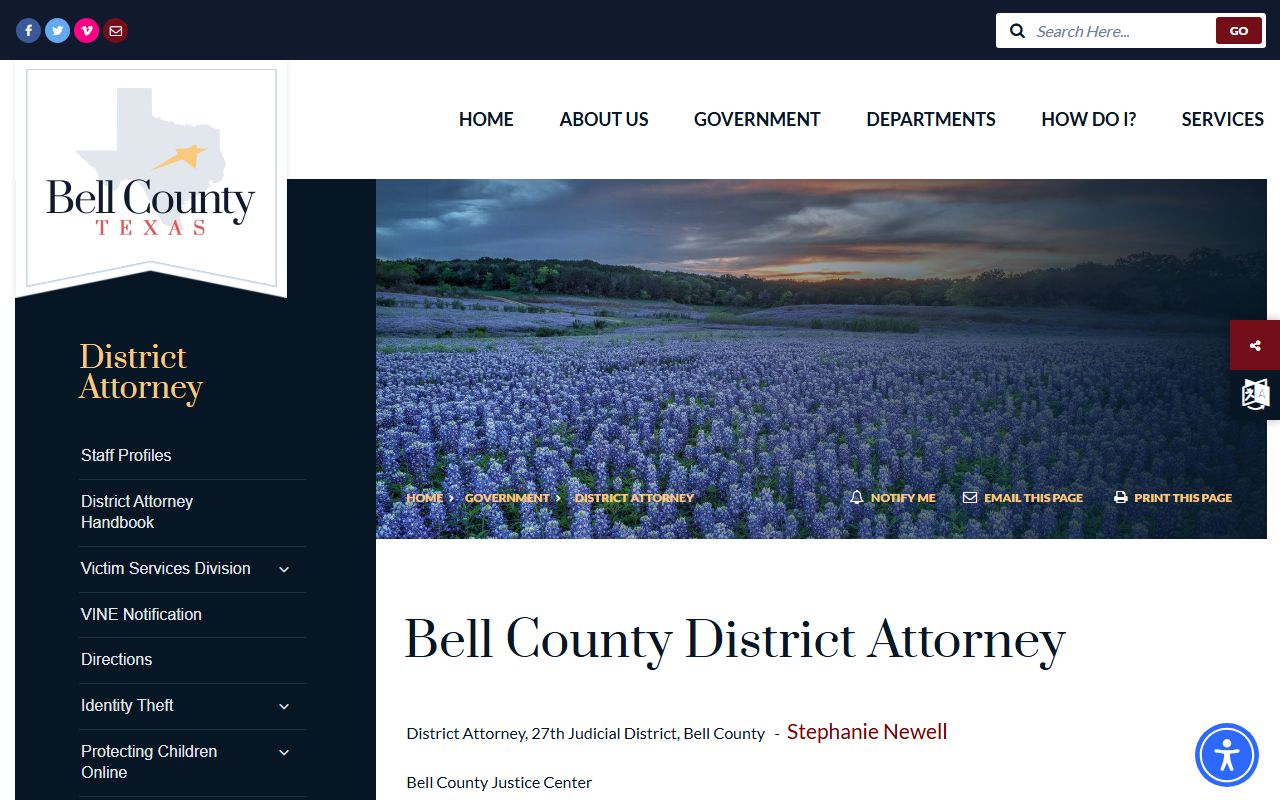
From that page, victims and the public reach the same forms and notification tools the office uses for active Bell County criminal cases.
Charges vs. Convictions
Being charged is not the same as being convicted. A charge is an accusation. It rests on probable cause, the low bar an officer or magistrate needs to make an arrest. A conviction comes much later, by plea or by verdict, and it needs proof beyond a reasonable doubt. Both stages can show up in public records, but they mean very different things about a person.
In Bell County jail data, you may see a deferred adjudication result, a dismissal, or a status like "Disposed - Payment Due." None of those is a plain guilty verdict. To learn the real outcome, read the disposition and judgment in the clerk file, not the arrest line. The table sorts the two stages.
| Charge | Conviction | |
|---|---|---|
| Stage | Accusation | Verdict or plea |
| Burden of Proof | Probable cause | Beyond a reasonable doubt |
| Where It Shows | Arrest and booking record | Court file disposition |
| Public Record | Yes | Yes |
Note: a person can be arrested, booked, and released without ever being convicted, so always confirm the final result in the court file.
Felony and Misdemeanor Record Split
Bell County does not keep all criminal files in one office. The split follows the court that hears the case. Felony cases go to the district courts, so the District Clerk's Criminal Department holds those records. Misdemeanors go to the county criminal courts, so the County Clerk holds those. This matters when you request a copy, because asking the wrong clerk slows you down.
For a name-based criminal search, the county lists a fee. The District Clerk charges $5 per name for a criminal record search through its public records process. To reach the County Clerk's criminal section, the county lists cccriminal@bellcounty.texas.gov and (254) 933-5161. The public case index for both levels runs through the county Odyssey portal.
The county Odyssey portal indexes felony and misdemeanor cases side by side.
| Record Level | Custodian | Court |
|---|---|---|
| Felony criminal | District Clerk, Criminal Department | 27th, 264th, 426th District Courts |
| Misdemeanor criminal | County Clerk, criminal section | County criminal courts |
| Class C / traffic | JP or municipal court | Justice and city courts |
Mugshots and Booking Photos
A mugshot is the booking photo taken during intake. Bell County inmate profiles can show more than one photo, each with a timestamp, since a person may be booked on more than one date. These photos appear in the public inmate profile while a person is in the system. A mugshot only confirms that a booking happened. It does not prove guilt.
Texas treats booking photos as public, but private mugshot sites that charge to remove a photo are a separate matter and not a county service. To see an official booking photo, use the county Inmate Inquiry Portal rather than a paid third-party site. The photo sits inside the same profile as the charges, bond, and docket number.
What Is Public and What Is Restricted
Texas starts from openness. The Public Information Act treats government records as open unless a law says otherwise. Arrest and booking data is largely public, and so are most adult criminal court files. But several categories are closed or limited. Juvenile records are confidential under Texas Family Code Chapter 58. Sealed civil-side records, expunged criminal records, and records under an order of nondisclosure are kept from ordinary public view.
Police and offense reports are a special case. Under Texas Government Code Section 552.108, an agency may hold back law enforcement and prosecution records while a case is active. Bell County's public records page warns that an offense report may not be released during an open investigation or prosecution, and may need to be resubmitted after the case closes.
The two main relief paths, expunction and nondisclosure, come from different laws. The county and the DA both point to these statutes when a person asks to clear a record.
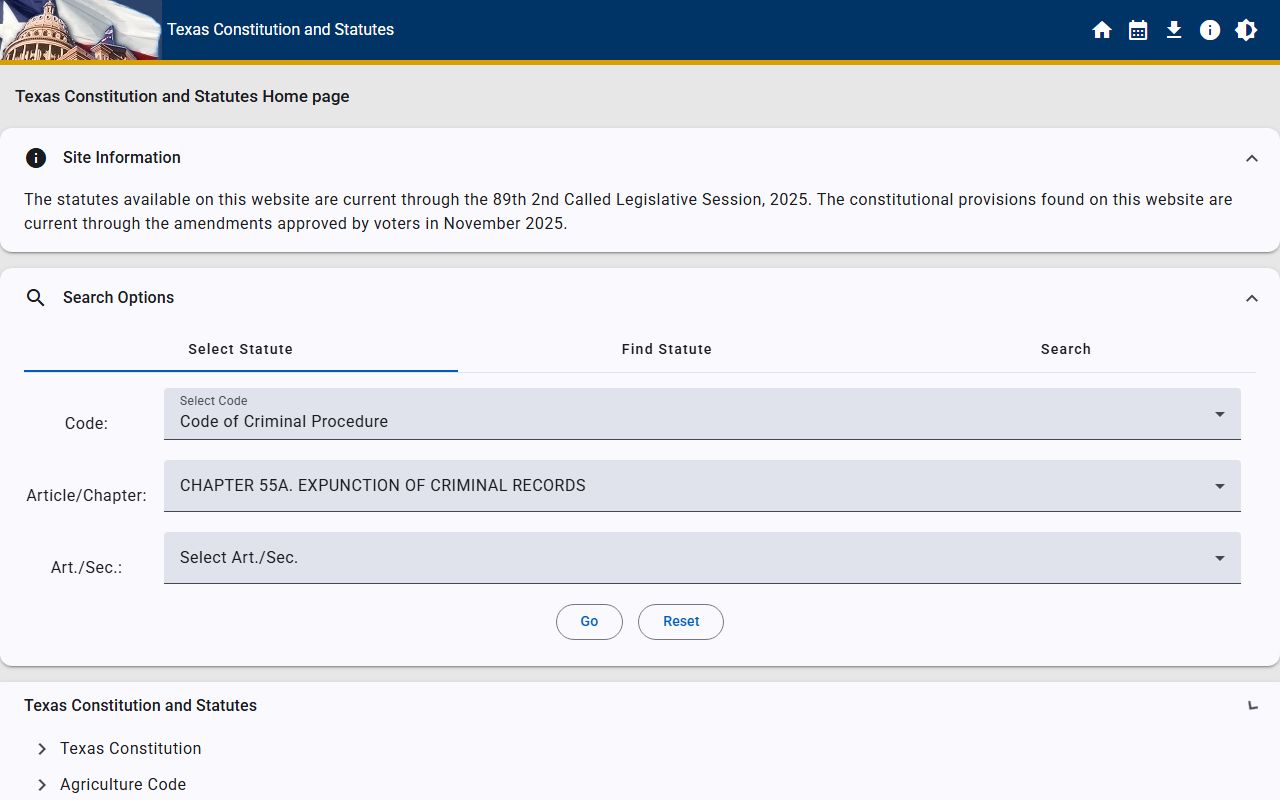
Chapter 55A sets who may erase a qualifying arrest, while Chapter 411 governs nondisclosure orders that hide a record from the public but not from criminal justice users.
Sealed vs. Expunged Records
Sealing and expunction sound alike, but they are not the same. A sealed record still exists. It is hidden from ordinary public access but may stay open to courts and some agencies. An expunged record is the stronger remedy. Under Texas Code of Criminal Procedure Chapter 55A, qualifying records are removed or destroyed and treated as if the arrest never happened.
Expunction usually fits arrests that did not lead to a conviction, acquittals, certain pardons, and mistaken identity. Nondisclosure, under Texas Government Code Chapter 411, fits some people who finished deferred adjudication. Both need a petition and a court order. The table sorts the difference.
| Sealed | Expunged | |
|---|---|---|
| Visibility | Hidden from public | Destroyed, treated as never existed |
| Law Enforcement | Limited access | Very limited |
| Texas Authority | Nondisclosure, Chapter 411 | Expunction, Chapter 55A |
| Typical Use | After deferred adjudication | No conviction or acquittal |
The nondisclosure rules and the state's limits on sharing criminal history both live in the same chapter of code.
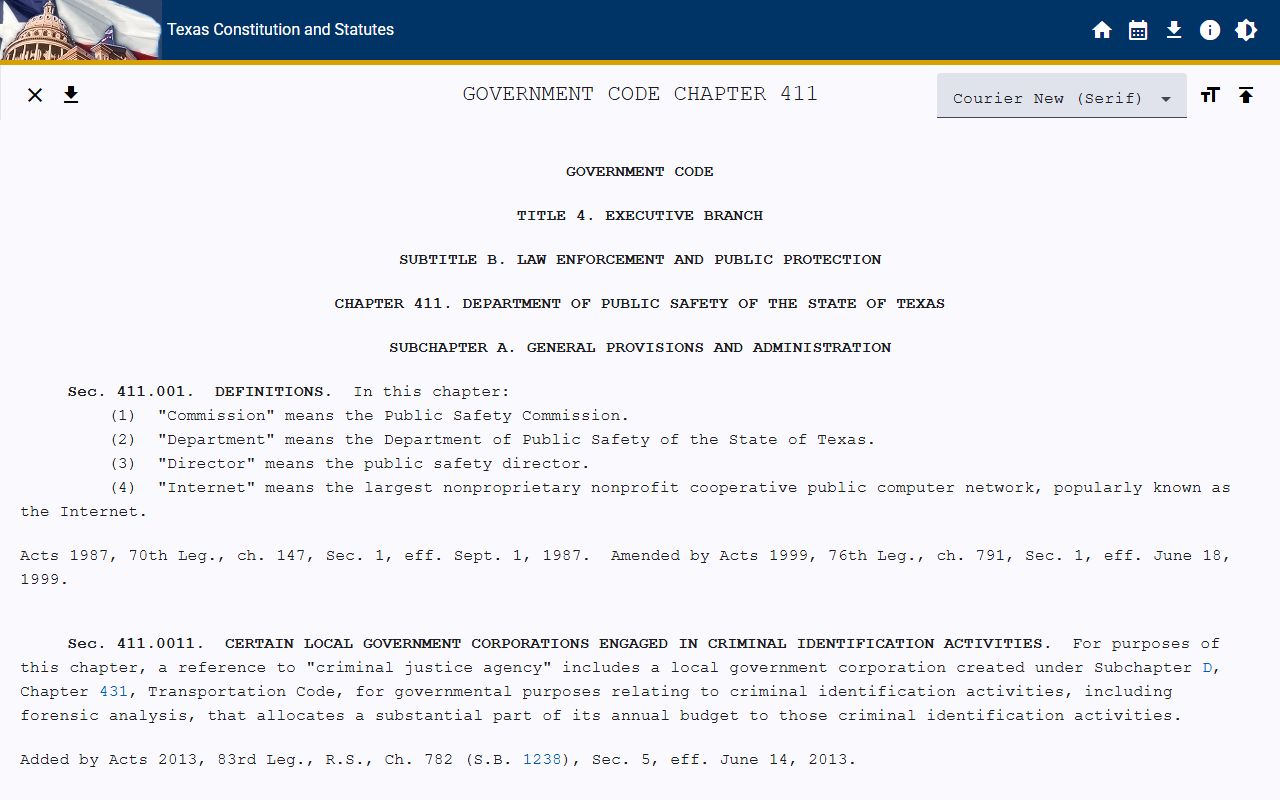
Chapter 411 also explains how DPS keeps criminal history and who may receive it, which shapes what a nondisclosure order hides from the public.
Statewide Criminal Records Search
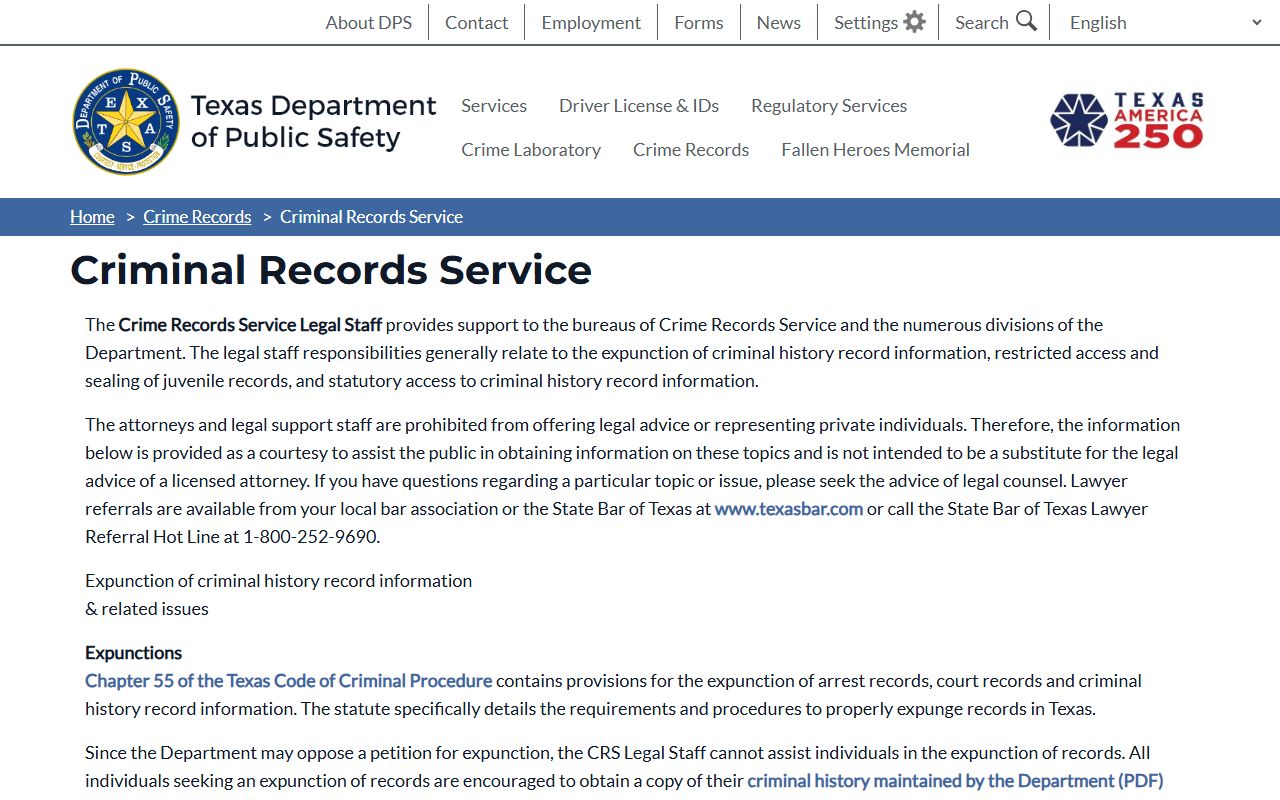
A county jail roster shows local bookings only. For a statewide criminal history, the source is the Texas Department of Public Safety. The DPS Crime Records Service runs the state Criminal History database, which can show convictions and deferred adjudications from across Texas, not just Bell County. DPS also explains expunction under Chapter 55 and nondisclosure under Section 411.071 on the same service.
The DPS Criminal History site offers public access checks for a fee, and named-based searches need identifiers to match the right person. This is a better tool than a single county roster when you need a full Texas picture.
The DPS Crime Records page links the public criminal history search and the rules for who can see what.
For sex offender data, Texas keeps a separate statewide registry that you can filter by county.
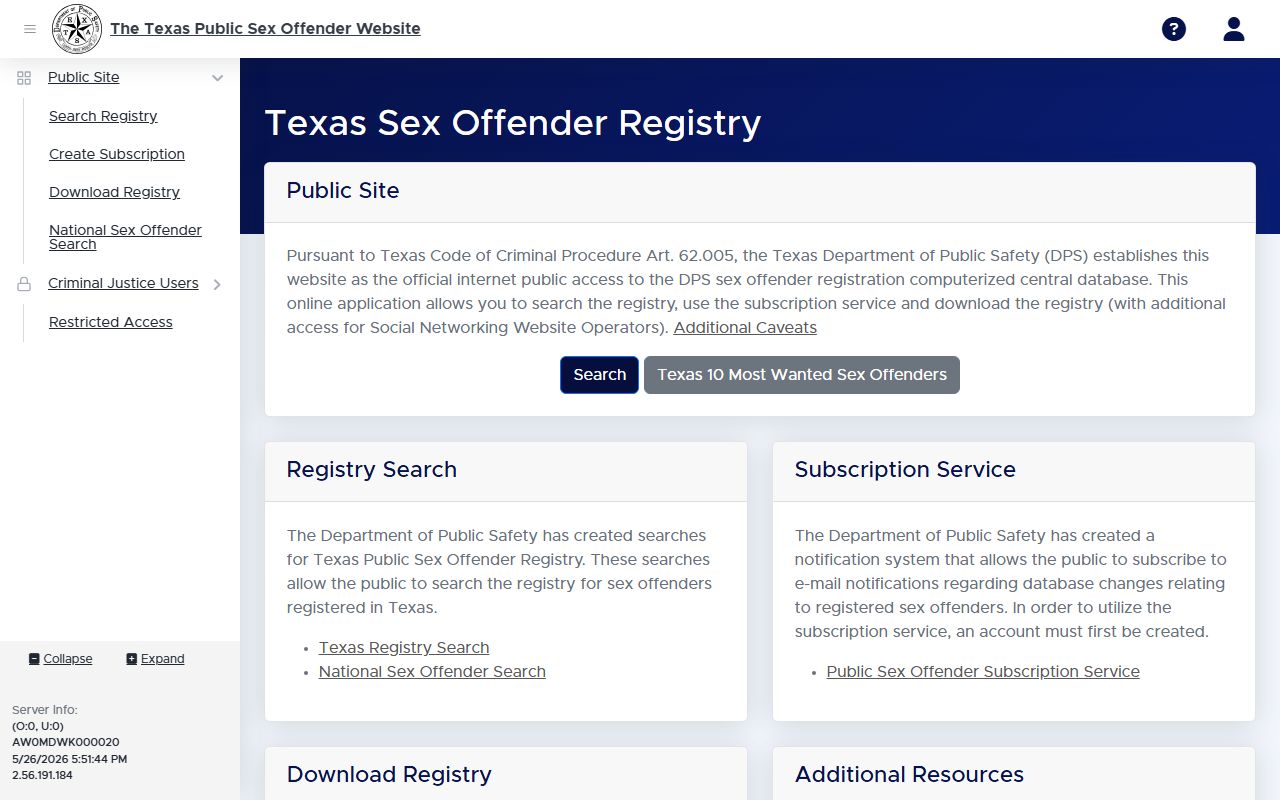
Pick Bell County in the registry to see local registrants, and call the Sheriff's registry line at (254) 933-6769 with questions about a local listing.
Background Check Considerations
A casual records lookup and a legal background check are not the same thing. If you want to make a hire, rent to a tenant, or grant credit, federal law steps in. Background checks for those uses must follow the Fair Credit Reporting Act and run through a licensed consumer reporting agency. A free roster search or a court index search does not meet that standard.
Important: This is not a consumer reporting agency under the FCRA. Do not use these records for credit, employment, tenant, or insurance decisions.
Restricted Criminal Records in Bell County
Some records stay closed no matter how you search. Juvenile justice files are restricted, and adoption, termination, and child protective services matters are confidential. Mental health commitments carry medical privacy limits. When a record does not appear in a public search, the law may be the reason, not a system error.
Access to a closed record usually belongs to a party, an attorney of record, an authorized agency, or someone holding a court order. Sealed and expunged records will not show in the county portal, in DPS results, or on private sites once the order is final. For request steps and timelines on open records, the Bell County public records page covers the process.