
What Probate Covers in Bell County
Probate is the court process for settling what a person leaves behind and for protecting people who cannot care for themselves. A Bell County probate file may hold a will, an estate administration, a guardianship, or a related matter. The court decides if a will is valid, who serves as the personal representative, and how assets pass to heirs. Some cases need full court supervision. Others move through a lighter process when the law allows it.
In Bell County these matters go to the county courts at law, not the district courts. County Court at Law 1 hears probate, with Judge Paul A. Motz presiding over the Probate Court. The County Clerk is the custodian, so applications, orders, and certified copies route through that office. Estate questions and guardianship questions have separate phone lines, which helps you reach the right desk faster.
Bell County Probate Terms Defined
Probate paperwork uses words you may not hear every day. The short list below explains the terms that come up most often in a Bell County estate or guardianship file.
- Testator
- The person who made the will.
- Executor
- The person named in a will to carry it out.
- Intestate
- Dying without a valid will, which sends the estate to state default rules.
- Guardianship
- Court-supervised authority over an incapacitated adult or a minor's person or estate.
- Conservatorship
- A related protective role over a person or property; in Texas family cases the term also covers child custody.
- Muniment of title
- A Texas shortcut that can pass title under a will without full estate administration when conditions are met.
- Independent administration
- A common Texas route with little ongoing court oversight after the representative is named.
- Dependent administration
- A more supervised route used for disputes, creditor problems, or when independent authority is not granted.
- Small estate affidavit
- A simplified path for a modest estate with no will, allowed under Estates Code Chapter 205 when the rules are met.
How to Search Bell County Probate Records
Two tools cover most probate searches. The county Odyssey portal holds the Civil and Probate Case Index, which runs from October 1989 to the present. The GovOS official records search holds recorded documents and lets you filter by document type, including Probate, Will, Small Estate Affidavit, and Guardianship. Use Odyssey for the case docket and GovOS for recorded papers. The steps below walk through a basic name search.
- Open the Bell County Odyssey portal and pick Smart Search.
- Type the deceased person's name in Last, First Middle Suffix format, or a case number.
- Set the location filter to County Court at Law #1 or all county courts at law.
- Review the index rows for the case number, parties, court, and status.
- For recorded wills or guardianship documents, switch to the GovOS official records search and filter by document type.
The small estate affidavit path is set out in Texas Estates Code Chapter 205, which explains when a modest estate can skip full administration.
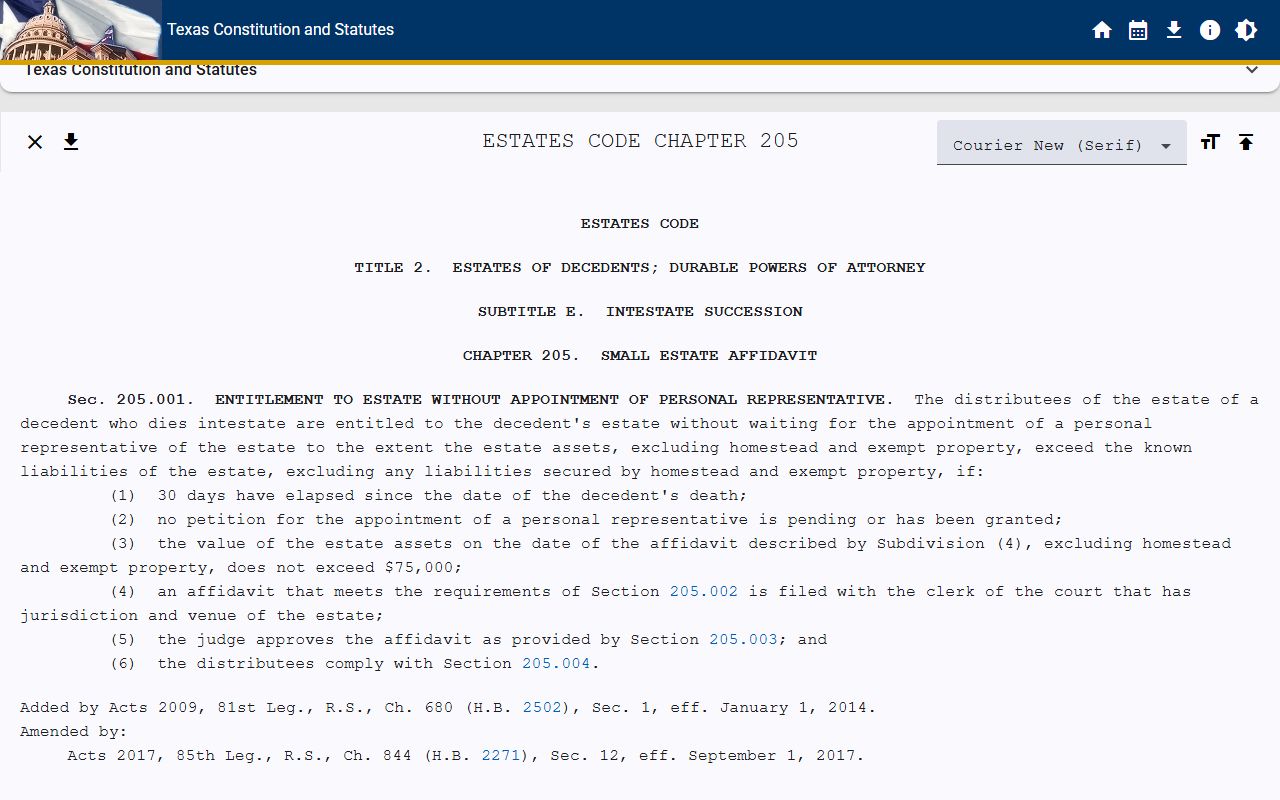
That chapter sets the dollar limits and the conditions a small estate must meet before the court will accept the affidavit.
Probate Courts in Bell County
Bell County does not have a stand-alone statutory probate court. Instead, probate sits inside the county courts at law. Court at Law 1 carries the probate docket, along with civil and mental health matters. The contact card below gives the office address and the separate lines for estates and guardianships.
County Court at Law 1 (Probate)
1201 Huey Road
Belton, TX 76513
Estates (254) 933-5473
Guardianship (254) 933-6722
Mon-Fri 8:00 a.m.-5:00 p.m.
County Clerk Civil & Probate
1201 Huey Road
Belton, TX 76513
(254) 933-5174
County.Civil.Probate@bellcounty.texas.gov
Mon-Fri 8:00 a.m.-5:00 p.m.
Note: estate filings and guardianship filings use different phone lines, so call the matching number to reach the staff who handle your case type.
The Bell County Probate Process
Most estates follow a familiar order. The exact path depends on whether there is a will, whether anyone contests it, and whether real estate or debts are involved. A clean, uncontested estate moves faster than one with missing heirs or creditor fights. The steps below show the usual flow.
- File an application with the County Clerk and the county court.
- Wait for a hearing setting and give any required notices.
- Prove the will or prove heirship at the hearing.
- The court signs an order admitting the will or naming a representative.
- The clerk issues letters testamentary or letters of administration.
- The representative files an inventory, handles creditors, and distributes assets.
A guardianship runs on its own track and stays under closer court watch, since it protects a living person. Will-based cases that qualify for muniment of title can skip much of the administration. Texas law on admitting a will to probate sits in Texas Estates Code Chapter 256.
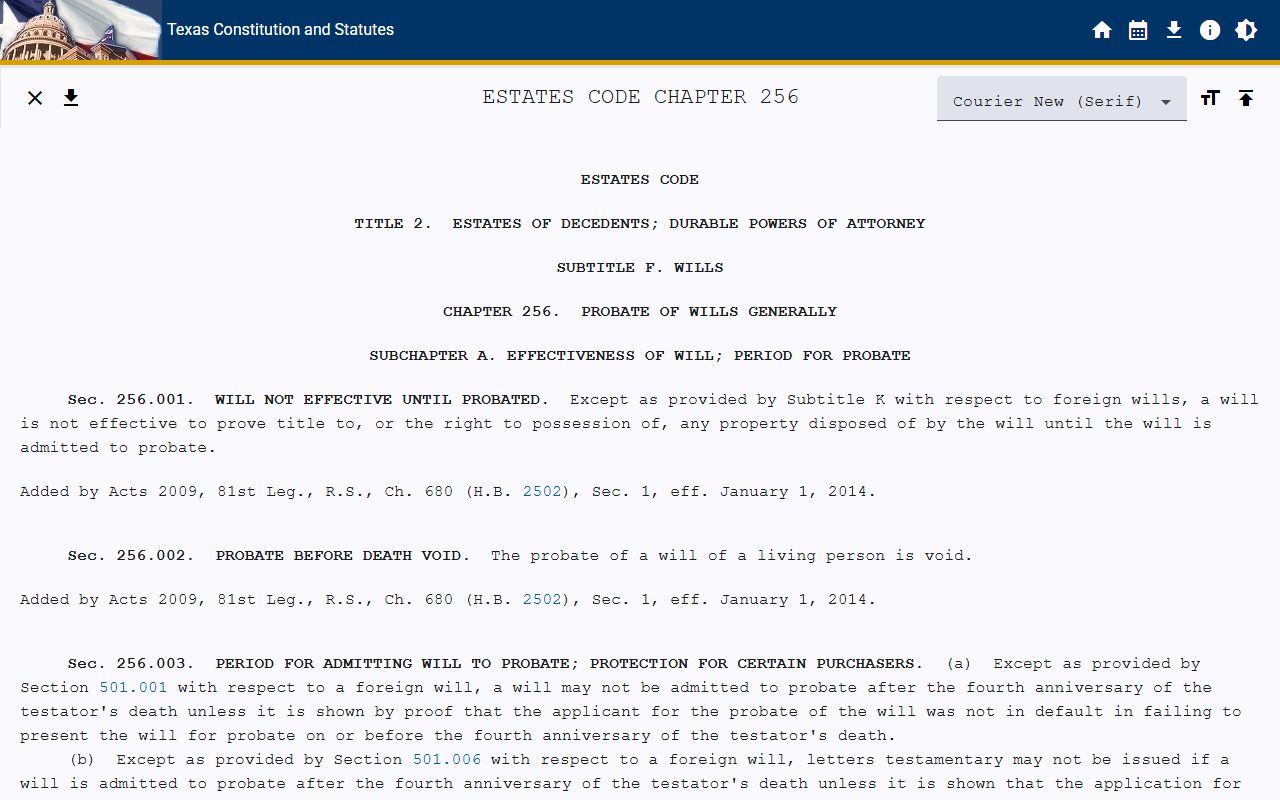
That chapter covers who may apply, the proof a court needs, and the time limits for offering a will.
Bell County Probate Fees and Copies
Probate filing fees and copy charges follow the County Clerk's fee schedule. The county links that schedule but does not fully post the dollar amounts online, so confirm current filing and certification costs with the clerk before you pay. Certified copies of probate documents, such as letters testamentary or a will admitted to probate, are requested from the County Clerk. Plan for a per-page copy charge plus a certification fee on top.
Note: amounts change, so call the County Clerk civil and probate line to verify the current fee before mailing a request or visiting in person.
What Bell County Probate Records Show
A probate file builds up over the life of the case. Early documents include the application and the will, if there is one. The court order and the letters come next. Then the file fills with the working papers of the estate. The table below lists the documents you are most likely to find.
| Document | What It Shows |
|---|---|
| Application to probate | The request to admit a will or open an estate. |
| Will | The testator's instructions, once filed and admitted. |
| Order admitting will | The court's ruling that the will is valid. |
| Letters testamentary or of administration | Proof of the representative's authority to act. |
| Inventory and appraisement | The list and value of estate assets. |
| Accountings and final distribution | How money moved and how assets were passed on. |
| Guardianship filings | Applications, bonds, and orders for a ward's care. |
GovOS document types echo these records, with categories such as Probate, Will, Small Estate Affidavit, Guardianship, Inventory, and Letter Testamentary.
Restricted Bell County Probate Records
Not every probate paper is open. Guardianship files are more confidential than a routine estate because they involve a living, often vulnerable, person. These files can hold medical records, financial account numbers, Social Security numbers, and details about minors. The clerk redacts protected identifiers from public copies.
Sensitive estate matters can also carry limits. A sealed exhibit, a minor's information, or a medical record may be kept from open view. If a probate record does not appear in the public index, that may be the law at work. To get a restricted record, you usually need to be an interested party, an attorney of record, or someone with a court order.